Beginner Japanese · Lesson 10
Make Your First Japanese Action Sentences
Build simple polite action sentences with checked verb forms, then add one specific time or weekday when useful.
Japanese first
Start with one complete action
Read the Japanese once for meaning. Then look at the three parts doing the work.
Your first action sentence
Reading: ごはんをたべます。
The English meaning uses “I” naturally. Japanese can leave the person unspoken when the context already makes that clear.
Meet ご飯 and 食べる
The vocabulary list gives the base word. The sentence uses a checked polite action form.
New word
ご飯
cooked rice; meal
This word can mean cooked rice or a meal; the opening sentence uses the meal meaning.
New word
食べる
to eat
One sentence, three jobs
See the Japanese in its original order
The opening example writes ごはん in Hiragana. The vocabulary spelling ご飯 is the same word.
Thing
ごはん
ごはん
the meal
Marker
を
お
marks the thing
Polite action
食べます
たべます
eat
Build a sentence
Put the thing before を
N を Vます
を comes after the thing the action directly applies to. The polite action comes at the end.
The particle is written を. In modern Japanese, when it works as this particle, it is normally pronounced like お. Keep writing を in the sentence.
The complete pattern
Reading: ごはんをたべます。
Meet more useful actions
Learn these as complete dictionary-form vocabulary words. Their checked polite forms come next.
New word
飲む
to drink
New word
書く
to write
New word
する
to do
New word
勉強する
to study
Learn 勉強する as the complete verb “to study.”
New word
休む
to rest; to take time off
This lesson uses the objectless polite form 休みます in a time sentence.
Base word and sentence form
Use the checked polite form shown
The vocabulary list keeps the base dictionary form. In polite sentences here, use the checked ます form beside it. This is a small set to use, not a rule for converting every Japanese verb.
- Dictionary form食べるたべる
- Polite sentence form食べますたべます
- Dictionary form飲むのむ
- Polite sentence form飲みますのみます
- Dictionary form書くかく
- Polite sentence form書きますかきます
- Dictionary formするする
- Polite sentence formしますします
- Dictionary form勉強するべんきょうする
- Polite sentence form勉強しますべんきょうします
- Dictionary form休むやすむ
- Polite sentence form休みますやすみます
勉強する(べんきょうする) is one learned verb, “to study.” In 宿題をします, 宿題 is the thing marked by を, and します means “do.” This does not make する a rule you can attach to any noun.
Meet things you can use with actions
These seven words now have a job inside short, useful sentences.
New word
水
water
New word
お茶
tea
New word
パン
bread
New word
宿題
homework
New word
手紙
letter
New word
テレビ
television; TV
New word
音楽
music
Use the new words
Keep the thing and action together
Read for the relationship first. 見る and 聞く return from the classroom lesson as familiar verbs, now in the checked polite forms 見ます and 聞きます.
水を飲みます。
Reading: みずをのみます。
I drink water.
手紙を書きます。
Reading: てがみをかきます。
I write a letter.
宿題をします。
Reading: しゅくだいをします。
I do homework.
テレビを見ます。
Reading: テレビをみます。
I watch TV.
音楽を聞きます。
Reading: おんがくをききます。
I listen to music.
を appears when there is a thing the action applies to. Some actions here, such as 休みます, do not need that object.
Ask about the thing
Use 何を食べますか
In this expression, 何を is read なにを. The reading of 何 depends on the complete expression; no new general reading rule is needed here. The familiar か makes the sentence a question.
A short conversation
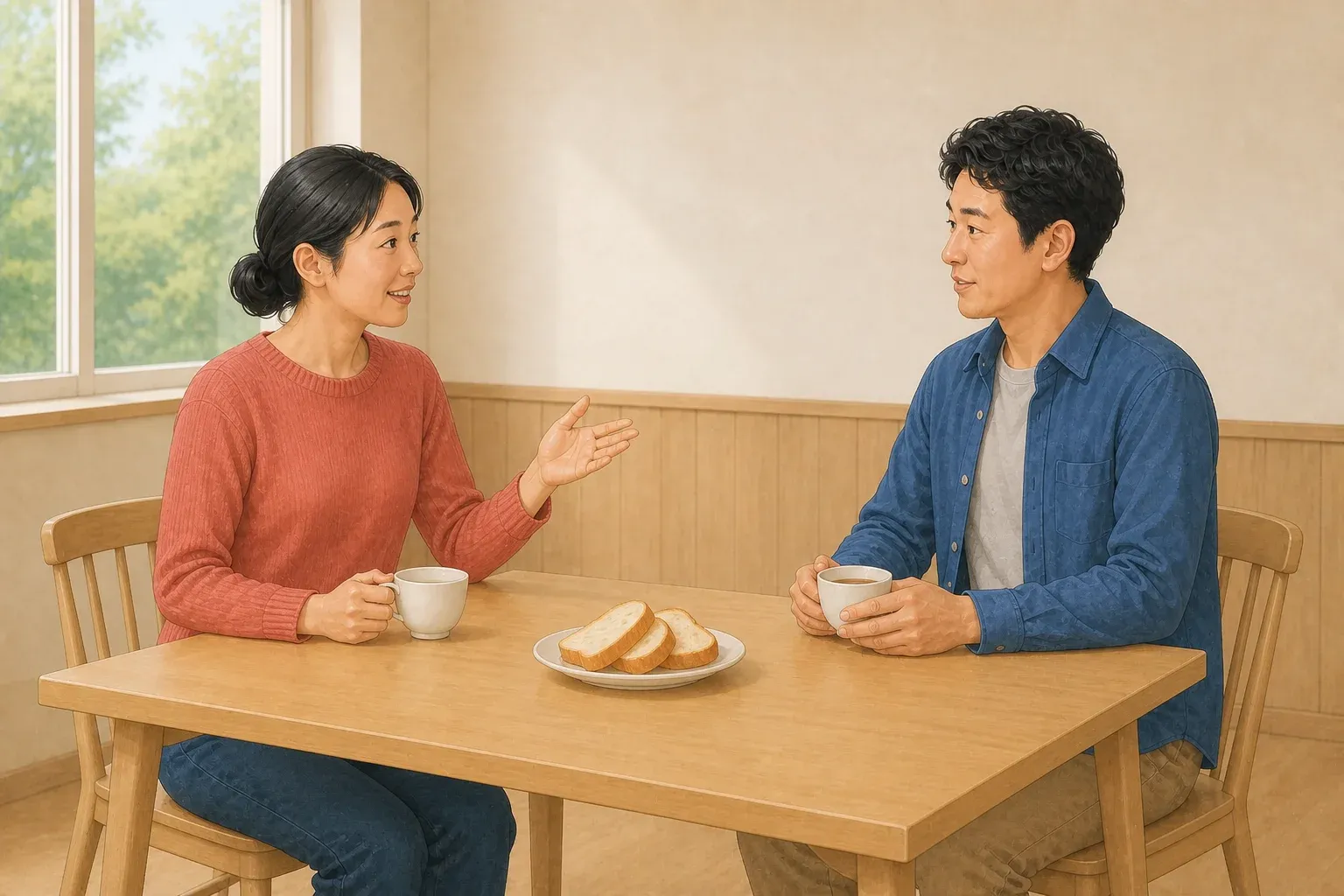
What will you eat and drink?
Read once for meaning, then notice what stays familiar as the food and drink change.
Speaker B
何を食べますか。
Reading: なにをたべますか。
Meaning: What will you eat?
Speaker A
パンを食べます。
Reading: パンをたべます。
Meaning: I eat bread.
Speaker B
何を飲みますか。
Reading: なにをのみますか。
Meaning: What will you drink?
Speaker A
お茶を飲みます。
Reading: おちゃをのみます。
Meaning: I drink tea.
Notice
- Here, 何を asks what the person will eat or drink. Read it なにを.
- The food or drink changes in each answer, but を still comes before the action.
Try another answer
Swap in ご飯 or 水 and say the sentence again.
Check your recall
Recall the core action pattern
Try each prompt before opening the answer.
Rebuild “I eat a meal” with the complete polite action sentence.
Show the sentence
ごはんを食べます。/ごはんをたべます。Keep the thing, を, and the checked polite action in that order.
水_飲みます。Which written particle belongs in the gap?
Show the particle
水を飲みます。/みずをのみます。Write を after 水. As a particle, it is normally pronounced like お.
お茶+飲みますJoin these into one action sentence.
Show the sentence
お茶を飲みます。/おちゃをのみます。I drink tea.
宿題+しますBuild the checked homework sentence.
Show the sentence
宿題をします。/しゅくだいをします。I do homework. Keep the explicit を in this model.
A short second step
Add a specific time with に
Once the polite action is clear, に can mark when it happens in the specific clock-time and scheduled-day examples here.
A specific clock time
Reading: ごごさんじにやすみます。
[specific time] + に + Vます
Put the specific time before に, then give the action. Notice that 休みます stands on its own here; there is no object with を.
A weekday, an object, and an action
Reading: げつようびににほんごをべんきょうします。
This lesson practises に with the specific clock time and weekday shown above. Do not treat に as something added to every time word.
Check your recall
Recall the question and time extension
Try each prompt before opening the answer.
Rebuild “What will you eat?”
Show the question
何を食べますか。/なにをたべますか。The known question ending follows the checked polite action form.
何をRetrieve the complete reading used here.
Show the reading
何を/なにをKeep this contextual reading with the complete expression.
午後三時+休みますAdd the marker that gives the specific action time.
Show the sentence
午後三時に休みます。/ごごさんじにやすみます。I rest at 3 p.m.
Rebuild “I study Japanese on Monday.”
Show the complete sentence
月曜日に日本語を勉強します。/げつようびににほんごをべんきょうします。The weekday takes に; 日本語 is the thing marked by を; the polite action comes last.
Keep the action pattern usable
- Put the thing before written を, then use the checked polite action form.
- As a particle, を is normally pronounced like お.
- 何を is read なにを in the question practised here.
- Not every action needs an object; 休みます works without one here.
- A specific clock time or weekday can take に in the two checked examples.