Beginner Japanese · Lesson 6
これ・それ・あれ: Talking About Things
Refer to a thing near you, near another person, or away from both people, then ask or answer what it is.
One scene, three positions
Build one map in your head
Picture two people and one object. The useful word changes with the object’s position from the current speaker’s point of view.
- これ
- this one near me
- それ
- that one near you
- あれ
- that one over there, away from both of us
Keep the same woman as the speaker in the next three scenes. Follow only the yellow camera.
Follow one object
Watch the camera move through the same room
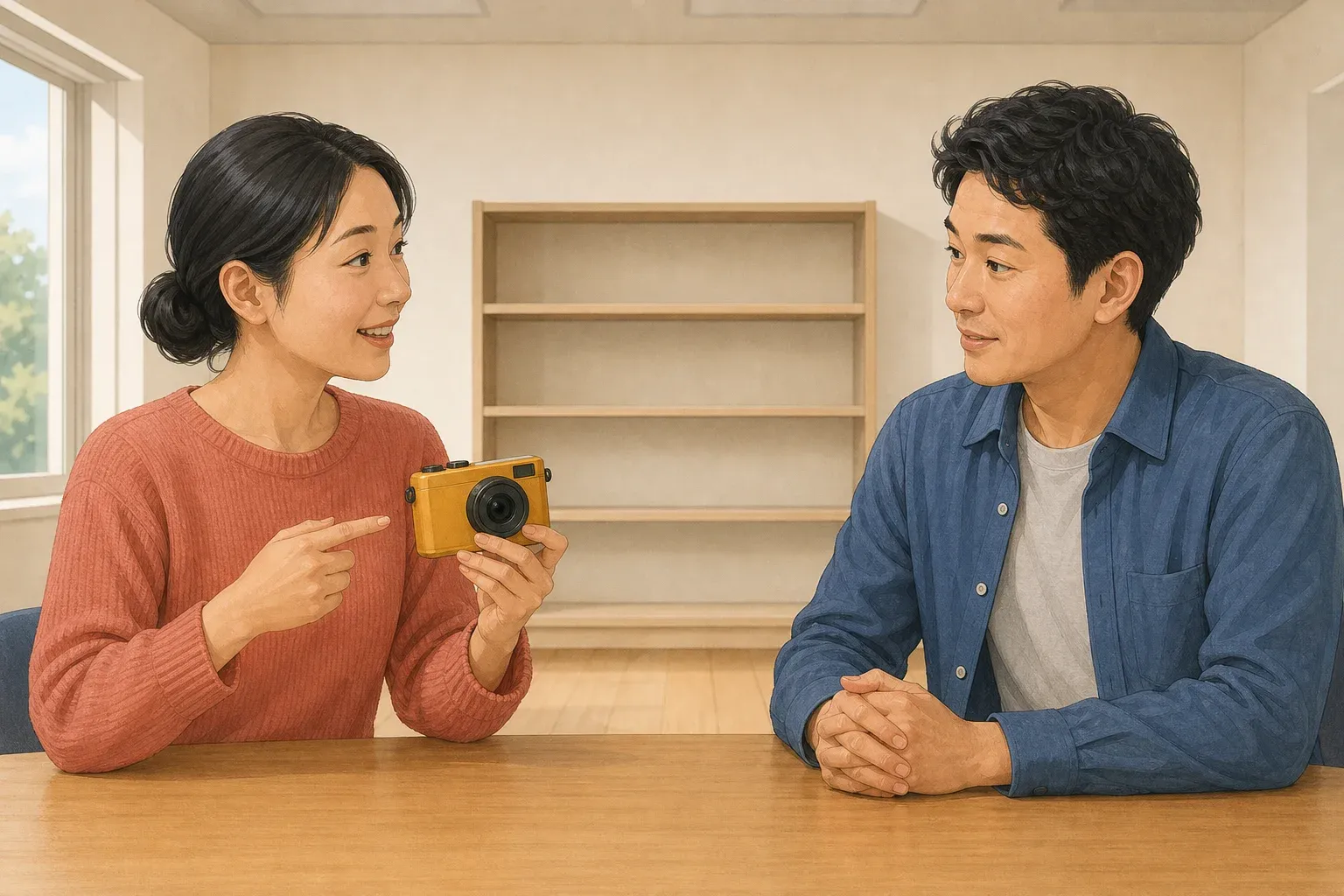
これ: near the speaker
The woman is speaking, and the camera is in her hands. It is inside her immediate space, so she can use これ.
Near the speaker
それ: near the listener
The woman is still speaking, but now the man holds the camera. It is near the person she is talking to, so she uses それ.

Near the listener
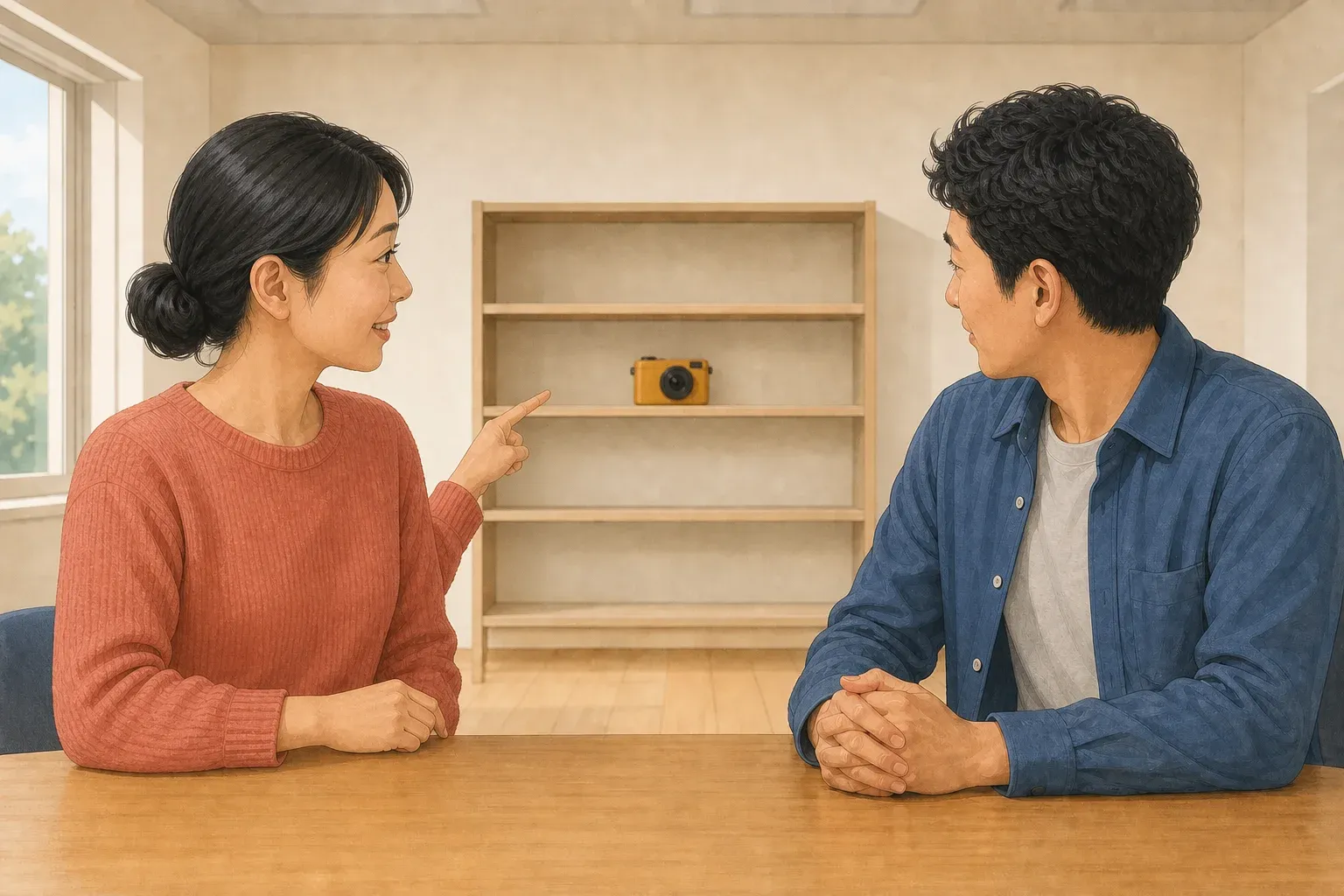
あれ: away from both
The camera is now on the shelf across the room. It is not near either person, so the woman uses あれ.
Away from both people
Keep the relationship
Compare the three positions
Do not memorize three loose English translations. Ask where the thing is relative to the person speaking now.
- これ
- Speaker sidenear me
- それ
- Listener sidenear you
- あれ
- Across the roomaway from both
The speaker matters. If the other person begins speaking, “me” and “you” change with them. Look again from the new speaker’s position.
Check your recall
Choose from the picture in your head
Imagine that you are the speaker each time. Name only the word that fits.
A camera is in your hands. Which word fits?
Reveal the speaker-side word
これThe object is near the speaker: near me.
A camera is in the other person’s hands. Which word fits?
Reveal the listener-side word
それThe object is near the listener: near you.
A camera is on a shelf across the room from both people. Which word fits?
Reveal the far-away word
あれThe object is away from both the speaker and the listener.
Four words that stand for things
The first three follow the distance map. The question word asks you to choose from a visible set; it is not a fourth position. None of these takes a noun directly after it.
New word
これ
this; this one
Use this for a thing near the speaker.
New word
それ
that; that one near you
Use this for a thing near the listener.
New word
あれ
that; that one over there
Use this for a thing away from both people.
New word
どれ
which one
Ask “which one?” when the noun is not said after the word.
Build a sentence
Identify a known thing
これ・それ・あれ + は … です
Choose one of the three known-thing words from the speaker’s position, then use the familiar identity pattern. The noun does not need to be repeated in the topic.
In the physical pointing situations in this lesson, the speaker–listener–object map is your guide. Keep これ, それ, and あれ as complete “thing” words; do not put a noun directly after them. どれ is the separate question partner: どれですか。 It does not mark another distance.
Known-thing question
Reading: これはカメラですか。
A small set of object words
These six concrete nouns give the distance words something useful to identify. Keep the set small and reuse it.
New word
本
book
New word
ペン
pen
New word
かばん
bag
New word
カメラ
camera
New word
つくえ
desk
Learn this everyday object word in Hiragana here.
New word
いす
chair
A known question word returns
Ask what the thing is
Review
何
what
You already know 何 and the question ending か. Put them to work with the new distance word.
Ask about the thing
Reading: これはなんですか。
Answer from the other side
Notice the viewpoint change. One person holds the camera and asks with これ. When the person across the table answers, that person becomes the speaker. The same camera is now near their listener, so the answer uses それ.
The same map, a different shape
Keep the distance when the noun follows
Sometimes you want to name the object immediately: “this book” or “that camera.” Keep the same three positions, but use a form that must be followed by a noun.
- この + noun
- near the speaker
- その + noun
- near the listener
- あの + noun
- away from both
Four words used before a noun
These use the same three-way map, plus one question form. Each word needs a noun directly after it.
New word
この
this; this ...
Use this before a noun near the speaker.
New word
その
that; that ... near you
Use this before a noun near the listener.
New word
あの
that; that ... over there
Use this before a noun away from both people.
New word
どの
which; which ...
Ask “which …?” and put the noun directly after it.
Build a sentence
Put the noun directly after the word
この・その・あの・どの + N
Choose the matching noun-following form to identify an object. Use its question partner before a noun when you are asking which member of a set.
Compare これ, “this one,” with この本, “this book.” これ本 and a bare この are not the lesson patterns.
Example
Reading: このほんはにほんごのほんです。
Example
One last shape choice
Ask “which one?” or “which book?”
Use どれ when the word stands for the thing. Use どの when you say the noun immediately after it.
The word stands alone
A noun follows
Reading: どのほんですか。
Check your recall
Keep the viewpoint and the word shape together
Decide where the object is, then check whether a noun follows.
これ / それYou hold a camera and ask what it is. The other person answers. Which word can that person use for the camera near you?
Reveal the answer from the new speaker
それFor the person answering, the camera is near the listener.
___ カメラThe camera is near the listener and the noun follows. Complete the phrase.
Reveal the noun-following form
そのカメラUse the listener-side form that goes directly before a noun.
どれ / どのAsk “Which book?” Which shape fits before the word for book?
Reveal the complete question
どの本ですか。Use the noun-following question form because the word for book follows immediately.
Keep one distance map
- これ is a thing near the speaker.
- それ is a thing near the listener.
- あれ is a thing away from both people.
- この・その・あの keep the same map, but a noun must follow.
- どれ stands for “which one”; どの comes before the noun.