Beginner Japanese · Lesson 1
Japanese Greetings for Everyday Moments
Recognize and choose a suitable greeting or social expression for a familiar everyday moment.
Start with the moment
Morning changes to daytime
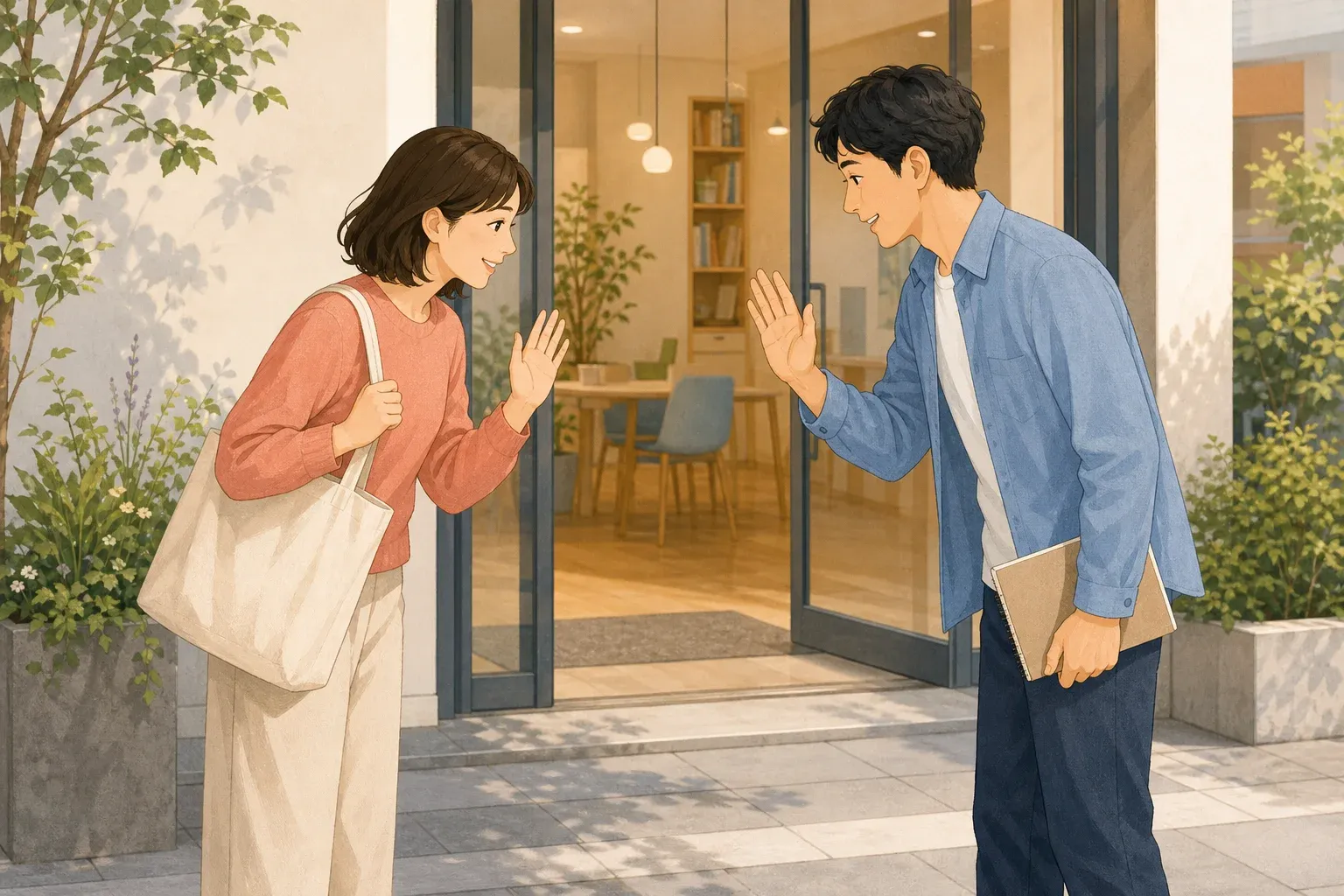
You arrive early and greet someone with おはようございます. Later in the day, こんにちは fits the moment instead. Read each expression as one useful greeting before you try to recall it.
In the morning
During the day
Choose a greeting by time
These three expressions are not interchangeable. Let the time of day give you the first clue.
New word
おはようございます
good morning
A polite greeting for the morning.
New word
こんにちは
hello; good afternoon
A daytime greeting.
New word
こんばんは
good evening
A greeting used in the evening.
In the evening
Check your recall
Pick the moment first
Try each prompt before opening the answer.
You greet someone at the start of the morning. Which expression fits?
Check the morning greeting
おはようございますUse this polite morning greeting.
It is evening and you are greeting someone, not going to bed. Which expression fits?
Check the evening greeting
こんばんはUse this as an evening greeting.
Thank someone or get their attention
The English reminder is short, but the situation still matters.
New word
ありがとうございます
thank you
A polite way to thank someone.
New word
すみません
excuse me; sorry
Useful for getting attention or making a brief apology.
Two small polite moves
Use ありがとうございます when someone has helped you or given you something. Use すみません to get someone’s attention politely; it can also make a brief apology. Later lessons can add more context, but these two uses are enough to act now.
Thank someone
Get attention
Check your recall
Retrieve the purpose
Try each prompt before opening the answer.
Someone helps you. Recall the polite expression for thanks.
Reveal the expression for thanks
ありがとうございますA polite “thank you.”
You need to get a teacher’s attention politely. What can you say first?
Reveal the attention-getting expression
すみませんThis can open the interaction politely.
Meet, finish the day, or take leave
Each expression belongs to a different kind of closing or beginning.
New word
はじめまして
nice to meet you
Use when meeting someone for the first time.
New word
おやすみなさい
good night
Use when saying good night, not as an ordinary evening hello.
New word
さようなら
goodbye
A clear leave-taking expression, but not the only way to say bye.
Evening greeting and good night are different
こんばんは greets someone in the evening.おやすみなさい belongs to bedtime or ending the night. It is not an ordinary evening hello.
さようなら is a clear leave-taking expression, but it is not a universal casual “bye” for every situation. Keep this bounded meaning now; other leave-taking expressions can come when the course gives them a useful context.
At bedtime
Taking leave
Check your recall
Read before revealing
Read the Japanese first. Then open the answer to check the situation, not just the English word.
はじめましてWhen would you use this?
Reveal the first-meeting context
Use it when meeting someone for the first time: “Nice to meet you.”
おやすみなさいIs this an evening hello or a bedtime expression?
Reveal the situation
It is a polite good-night expression used around bedtime or when ending the night.
Keep these distinctions
- Choose おはようございます・こんにちは・こんばんは by the moment.
- Use ありがとうございます for thanks and すみません to get attention politely.
- Keep こんばんは separate from bedtime おやすみなさい.